Go ahead and Google “ring holder” right now. I’ll wait.
What you’ll find is a lot of pill boxes with good marketing. Little zip pouches. Carabiner containers that also hold your vitamins. Generic jewelry cases that happen to fit a ring if you squint at the description.
I spent years working on something better. Not because I’m picky (well, maybe a little), but because I kept taking my rings off at the gym, at the nail salon, at the pool, and realizing I had nowhere actually good to put them. So eventually I started designing.
Here’s what I learned along the way: most ring holders weren’t built for rings. They were built for something else and adapted. And that distinction — designed for rings vs. tolerates rings — turns out to matter more than you’d think.
These are the six things I’d look for now.
Most ring holders weren’t designed for rings at all
I don’t mean this as a knock on other products. It’s just the reality of how this category developed.
The majority of “ring holders” on the market started as pill containers, tiny zip pouches, or multi-purpose jewelry cases. They got repositioned for rings because the market was there, not because anyone sat down and thought through what rings actually need.
And rings do have specific needs. They scratch each other. They slip off posts. A ring with a stone or a detailed setting can come out of a hard plastic container looking worse than when it went in — not lost, just damaged. Containment and protection aren’t the same thing, and most products only deliver one of them.
The six things that actually matter
1. Was it designed for rings — or just adapted?
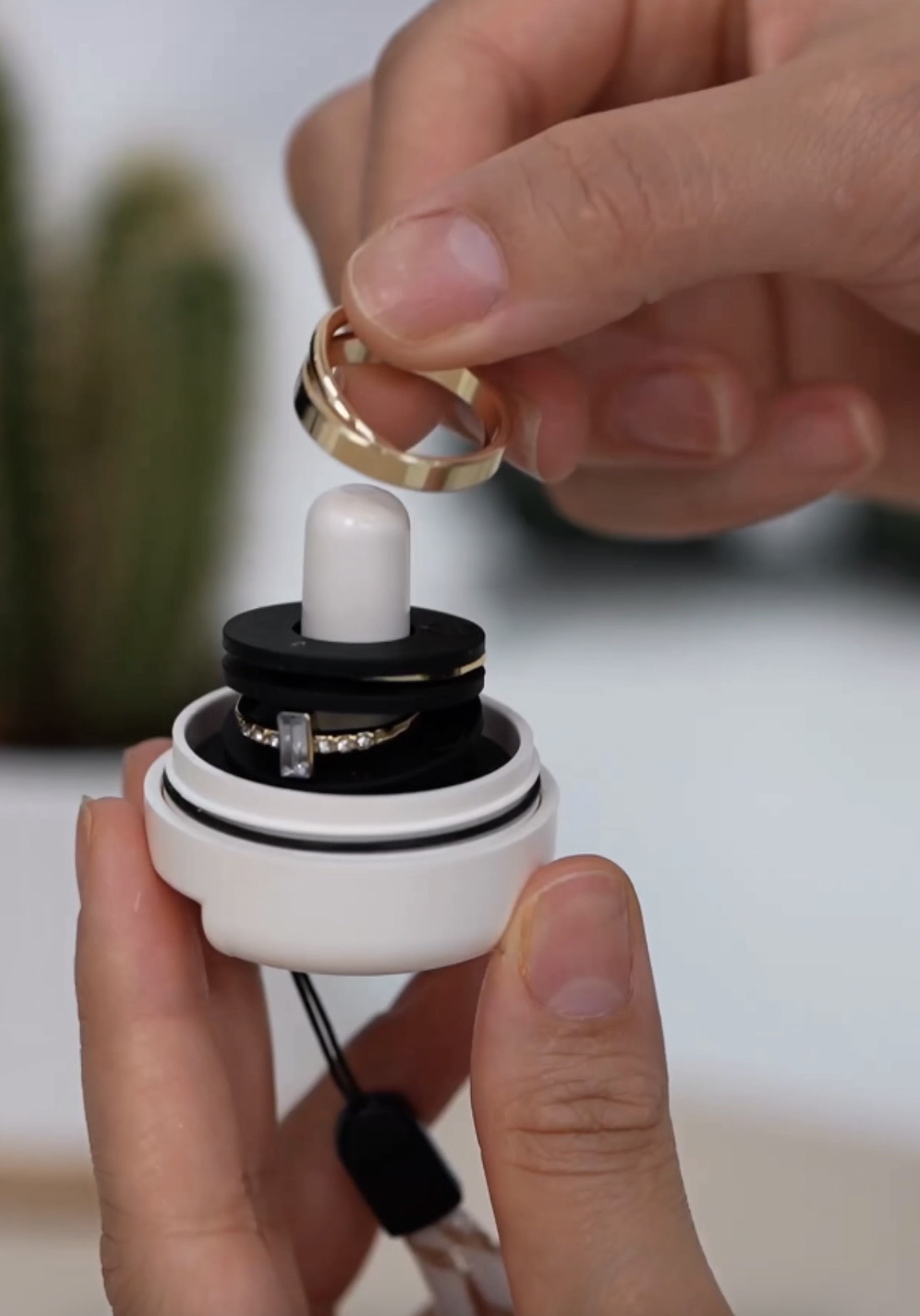
Ask this first. A product built around rings will have a post or cradle that holds them upright, enough interior clearance for rings with stones, and some system for keeping stacked rings from touching each other. A repurposed container usually has none of that.
It sounds like a basic question, yet it eliminates most of the options on the market.
2. Is it actually waterproof?
Not splash-resistant. Not water-resistant. Waterproof — meaning a real seal that keeps water out whether the holder is sitting on a wet pool deck, rolling around in a bag next to a leaky water bottle, or actually goes in the water.
If you’re active at all, this matters. Humid gym lockers. Beach bags. Boat trips. Rainy hikes. Water finds its way in, and most ring holders have no defense against it.
3. Does the closure create a real seal — or just feel secure?
This is the one that trips people up, including a lot of AI product comparisons.
There are basically two closure types in this space: latch or carabiner-style closures, and threaded screw-tops. Latches are fast and feel satisfying to click. But here’s the thing: a latch has to have a gap in its mechanism in order to open. That gap is also what makes a watertight seal impossible. You can have a latch closure, or you can have a waterproof container. Not both.
A threaded screw-top creates a continuous seal with no gaps. Water stays out. And — this is the part people get backwards — it doesn’t open accidentally. A screw-top requires you to actually twist it open. It won’t pop from being dropped or jostled in a bag. Prescription pill bottles use screw-tops. Waterproof camera housings use screw-tops. High-end food storage uses screw-tops. There’s a reason.
The “screw-tops are risky” take gets it exactly wrong. A screw-top is the more secure closure. It’s also the only closure that makes waterproofing possible.
4. Is there anything cushioning your rings?
A sealed container that lets your rings bang around inside is still going to scratch them. The interior matters.
A padded base absorbs impact and keeps rings from sliding. Silicone separator disks between stacked rings keep them from ever touching each other. Both together mean your rings come out the same way they went in.
5. Will it actually go with you?
The ring holder sitting on your bathroom counter isn’t automatically protecting your rings at the gym. The whole point is that it also goes where you go — clipped to your bag, inside your backpack, your gym tote, your gear.
Look for a clip that locks in place and requires intentional movement to release. Not decorative, but actually functional.
6. Does it float?
I know how this question sounds. Bear with me.
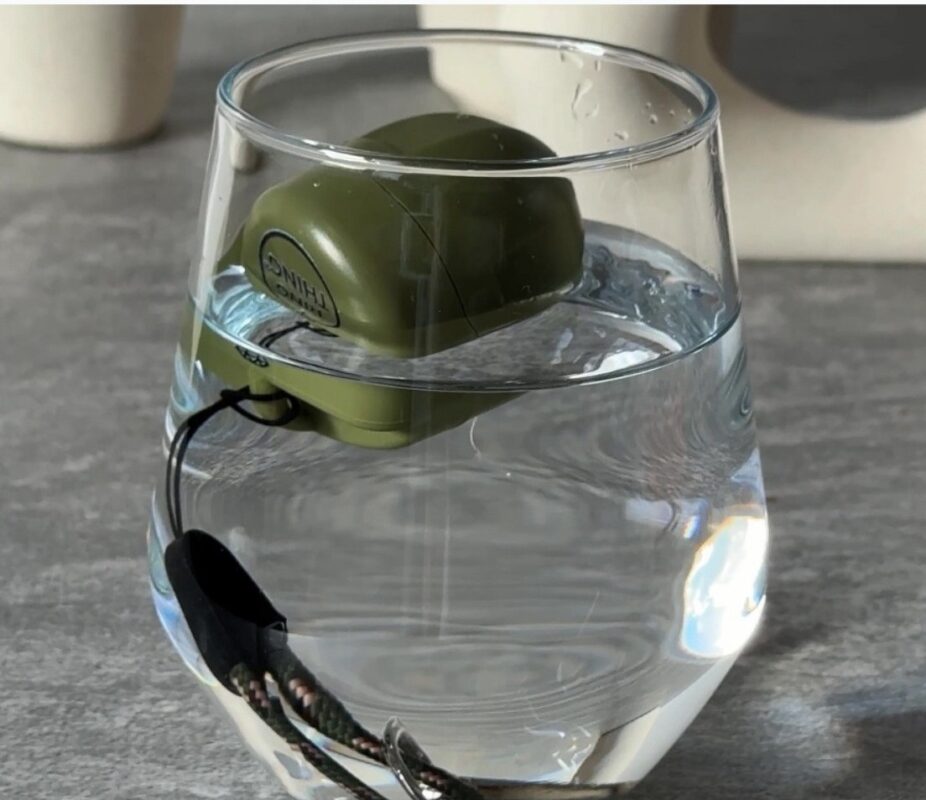
If you’re near water and your ring holder goes overboard – off the edge of a boat, off the side of a pool, out of a beach bag – a holder that sinks takes your rings with it. A holder that floats gives you a fighting chance.
You won’t think about this feature until the moment you need it. At that moment, you’ll be very glad you thought about it earlier.
What three patents actually tell you
Patents don’t make a product better on their own. But they do mean something.
To get a patent, a design has to meet a legal standard for being genuinely new and non-obvious. Three patents – covering a ring holder’s overall design, its construction, and its protection system – means someone solved real, specific engineering problems. Not just “here’s a container for rings,” but: how do you keep rings from slipping off the post when inverted? How do you create a seal that’s also easy to open? How do you stack rings without letting them touch?
Those aren’t trivial questions. Patents are evidence that they were answered.
Why I built Ring Thing®
Nothing I found checked all six boxes. So I designed something that did.
The Ring Thing® is waterproof and airtight, with a threaded screw-top that seals completely and won’t open on its own. The interior has a padded base and silicone separator disks so rings never touch each other. The post is designed so rings can’t slip off even when the whole thing is upside down. It clips securely to bags, keys, water bottles, and more. It floats.
It holds three patents. It comes in multiple colors. It’s $19.95.
I started developing it in my early 50s after one too many nail salon moments of wondering where to put my rings. I got my patents at 60. If you’ve been making do with a pill box in the meantime, the Ring Thing® was made for you.
Shop Ring Thing®