If you climb, you’ve heard the rule.
Take your rings off before you get on the wall. Every gym posts it. Every instructor says it. And they’re right to say it, because ring avulsion is a real injury and a real risk, and no ring is worth what can happen to your finger if it gets caught on a hold.
I want to talk about that risk. And then I want to talk about the part that never gets answered: where are your rings actually supposed to go?
What Ring Avulsion Actually Is
Ring avulsion happens when a ring catches on something — a hold, a crack, an edge — while your body keeps moving. The ring stays. Your finger doesn’t.
It can range from bruising and tissue damage all the way to degloving or, in the most severe cases, amputation. It’s serious enough that climbing gyms post warnings about it at the wall.
Jimmy Fallon suffered a ring avulsion injury just walking through his kitchen. He tripped on a rug and while falling, his wedding ring got caught on the edge of a countertop. It put him in the hospital for 10 days. Climbing, with its grip-intensive moves and rough surfaces, creates the exact conditions where this type of injury becomes a real possibility.
So yes. Take your rings off before you climb.
The Advice That Stops Too Soon
Here’s where most ring avulsion guidance stops short.
It tells you to remove your ring. It suggests switching to a silicone band. And then it goes quiet on the most practical question of all: what do you do with your ring?
Silicone rings are often presented as the answer. The idea is that a silicone band will break away under enough force rather than holding like metal. And it’s true that silicone fails at a much lower force threshold than a metal ring.
But silicone rings can still snag. Research published in the Journal of Hand Surgery* found that in a clenched fist position — the same grip you use on a climbing hold — the force required to break a silicone ring nearly doubles. The breakaway property that protects you in a straight-pull emergency becomes significantly less reliable when your hand is actively gripping. Some climbing gyms recommend no rings on the wall regardless of material, because the risk doesn’t fully go away just because you’ve switched materials.
The real answer to ring avulsion isn’t wearing a different ring. It’s taking your ring off. The question is what happens next.
A lot of climbers don’t want to leave their engagement ring, their wedding band, or a ring that holds real meaning to them sitting loose in a locker, tucked in a pocket, or left in the car. They want it off their finger and safe — not absent. Every piece of advice focuses on protecting your finger. No one talks about protecting your ring.
Where Your Ring Should Actually Go
When I started developing the Ring Thing®, climbers weren’t my first thought. I was sitting in a nail salon, trying to figure out where to put my rings during my manicure, and I realized I had nowhere safe to put them. I was sticking them into whatever bag or pocket was nearest and hoping I’d remember where they were.
The same problem kept showing up. At the gym. At the pool. Traveling. Every time I took my rings off, I was improvising — setting them on a counter, tucking them in a pocket, dropping them into a purse with no padding, hoping for the best.
That’s not protection. That’s luck.
So I spent eight years designing something built specifically for rings. I was working full-time and designing the Ring Thing® in the evenings and on weekends. I got my first patent at 60. And when I started talking to climbers, I realized the Ring Thing® solved their problem too — maybe better than anyone else’s.
Here’s what I’d want to know if I were a climber evaluating this.
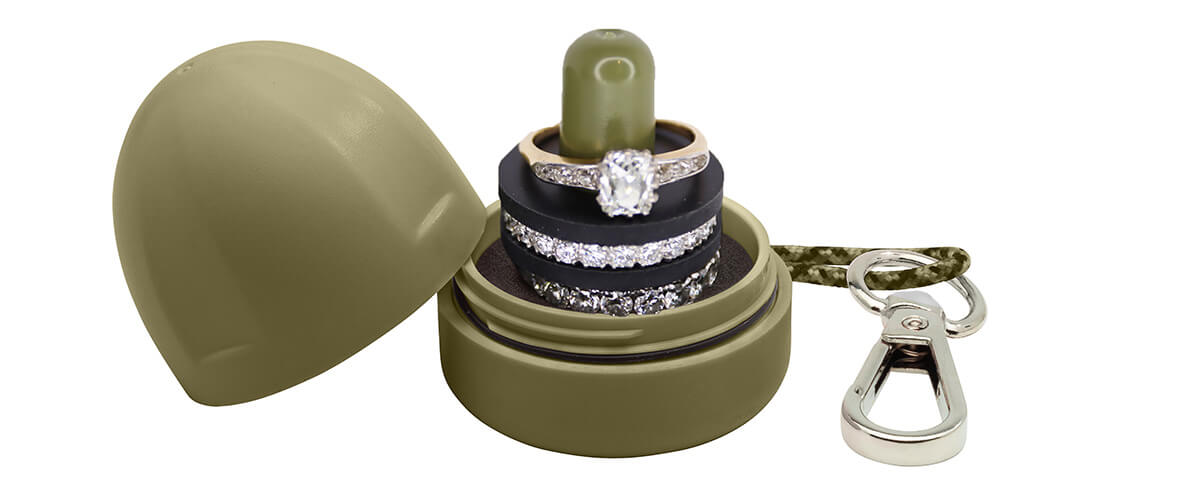
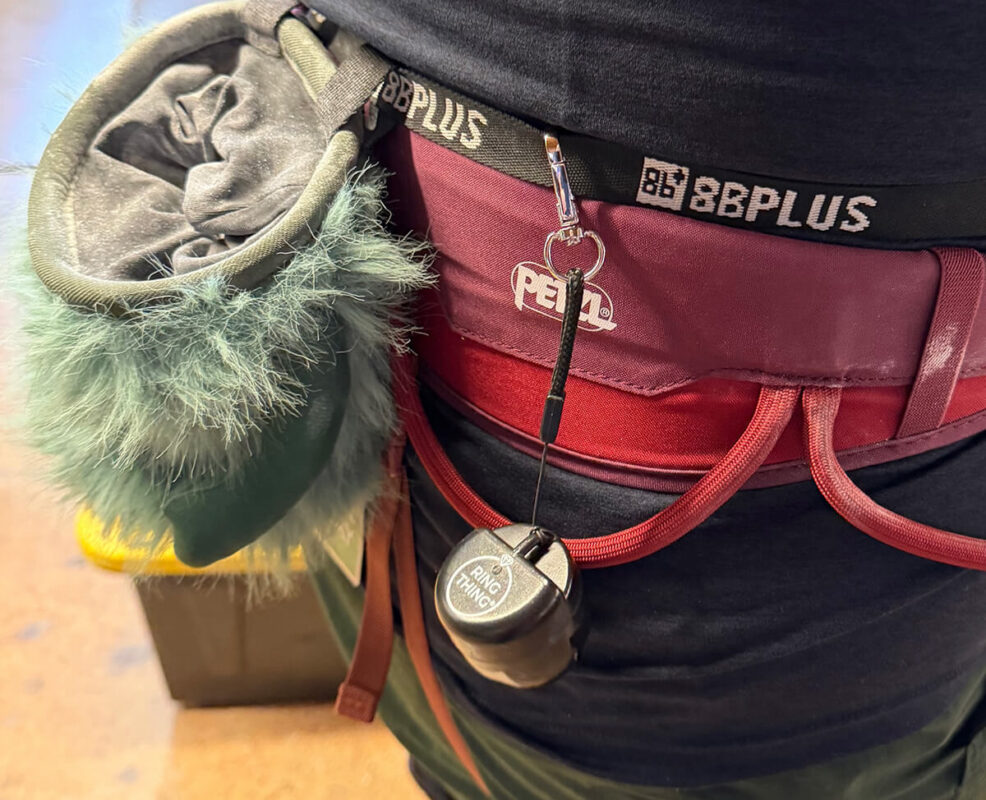
It stays with you. The Ring Thing® clips to your chalk bag, your harness, inside your pack, onto your keys. Wherever your gear goes, your rings go with it.
It’s waterproof and airtight. If you’re climbing near water, doing a multi-pitch with a creek crossing, or just have a water bottle rolling around in your bag next to your rings — water is not a concern. The Ring Thing® floats, too. If it goes overboard, it pops right back up to the surface.
Your rings don’t touch each other. The padded base and silicone separator disks mean a diamond setting isn’t grinding against a plain band all day. What goes in protected stays protected.
It won’t open on its own. Think about how we trust screw-top closures in everyday life — medicine bottles, vitamins, water bottles, olive oil, baby food. When something matters and you need it sealed, it gets a screw top. A threaded closure requires you to actually twist it open. It won’t pop from impact, from being dropped, or from a carabiner snagging it on your harness. The precision seal is part of the patent — it’s not an afterthought.
Climb With Purpose
Before I go, I want to tell you about one more reason the Ring Thing® belongs in the climbing community.
When I started partnering with climbing gyms and connecting with the climbing community, I learned about Never Solo, a nonprofit dedicated to preventing sexual abuse in the climbing community. They work with gyms, coaches, parents, and athletes to provide education, resources, and support.
I wanted the Ring Thing® to stand for something bigger than the product itself. So we made a commitment: 10% of all climbing-related Ring Thing® sales are donated to Never Solo.
When you buy a Ring Thing® as a climber — at a climbing gym, at a climbing event, or using the code CLIMB10 at checkout — your purchase does two things. It protects your rings. And it helps protect your community.
Use code CLIMB10 at checkout for 10% off your order.
Common Questions From Climbers
Do I have to clip it to my gear? Not at all. Some climbers keep it in their locker alongside their wallet and street clothes so everything is in one place when they’re done. The clip is there when you want it — it’s just one more option.
Will the Ring Thing® work with my engagement ring if it has a stone? Yes, in most cases. The Ring Thing® has held rings with raised settings up to a size 12.5 and beyond, and the inner post keeps them secure. The padded base and separator disks mean the stone setting isn’t sitting directly against another surface. If you have an unusually tall cathedral setting, reach out and I’m happy to talk through fit with you.
What’s the best place to clip it while I’m climbing? Most climbers clip it to their chalk bag or to a gear loop on their harness. It’s compact and light enough that you genuinely forget it’s there between burns.
What if I’m bouldering and don’t have a harness? Clip it inside your bag, onto your water bottle, or to the loop on your chalk bag. The clip locks in place and requires intentional movement to release — it won’t come off on its own.
Can I use the Ring Thing® for more than just climbing? Absolutely. The gym, the salon, the beach, the golf course, travel — the same reasons you take your rings off for climbing apply everywhere you’re active. The Ring Thing® was designed for all of it. Check out what to look for in a ring holder if you want the full breakdown of what makes a ring holder actually ring-specific.
*Source: Bray, B. et al. “Avoiding Ring Avulsion Injuries With Silicone Rings: A Biomechanical Study.” Journal of Hand Surgery, Vol. 46, Issue 8, August 2021. jhandsurg.org